
„A conference like COP is quite incredible"
How do you perceive the mood at COP31?
The message that we’re heading beyond 1.5 degrees is one you hear very clearly here. But I don’t sense that people in the climate community are giving up and saying, “It’s all over now anyway.” The attitude is more like: Every tenth of a degree counts. We have to keep going. People aren’t getting discouraged.

Leidy Bedoya and Oliver Marchand at COP31 in Anatalya
At the same time, this COP’s Action Agenda feels a bit watered down to me. My impression is that previous COPs had a more ambitious, positive direction. But among the people I’m meeting here, I still don’t sense any resignation.
What can you realistically expect from a COP anyway?
Before I left, I obviously told people around me that I was going to COP. Some of them were like, “Why are you even going there?”. COP has never been particularly popular with the public, but this time I found the reactions to be extreme.
I think many people have a very preconceived notion, which is also tied to completely exaggerated expectations. Who can really expect that around 200 countries will come together, have to reach a consensus on a decision, and then make huge leaps forward?
This consensus-building process is probably a design flaw in the UN climate process. But even without the consensus-building process, one couldn’t expect things to move forward extremely quickly.
We’re talking about an incredibly complex problem with technical, economic, and social challenges. The benchmark shouldn’t be: Will COP solve the climate problem within a few years? Instead, it should be: Is this the best process we as a global community can achieve, or can we make it better?

Session at the UNFCCC Innovation Hub – AI at the Climate and Health Nexus: Closing the Evidence Gap
And of course, we could make it better. But it’s certainly much better than no process at all. And what’s often forgotten is all the additional benefits: Beyond the treaty text that ultimately gets agreed upon, people come together and exchange ideas. The public hardly notices that. I can understand that, too. After all, what do we really know about networking events in other industries?
What do you personally like about COP?
The encounters.
A conference like COP is quite incredible. On one hand, you run into many old acquaintances. Even though there are so many people here, you just bump into each other. I find that really impressive.
On the other hand, you get to know a lot of new people. It’s a place where the climate community comes together. That mix of catch-ups and new conversations is what makes it so special to me.
Which conversations did you find particularly interesting?
I spoke with people from Rwanda and Uganda who were very interested in our work. And also with people from Tuvalu.
These are people who, I believe, could really use the support of our platform. That’s why I’m interested in seeing if we can also do projects in the Global South in the future. I think our platform could not only make economic sense there, but also have a direct and significant positive impact on people’s lives. Of course, implementation in the Global South is also difficult. We’ll have to figure out how that can work. But it’s definitely a prospect that interests me a lot.
Is there anything that frustrates you about COP?
What bothers me most, perhaps, are the many high-level panel discussions where more and more demands are being made.
People say: We also need to think about equity. We also need to think about the interoperability of digital systems. We need to make sure everything happens fairly. There's always one more thing, and then another. I also could list all sorts of things that still need to be done or should be done. But if you aren't personally responsible for implementing a solution, it's relatively easy to set requirements.
Personally, I’m much more interested in the question: How are we actually going to do all this? I’d like to talk more about that, rather than just defining the conditions.
What would you like to see more of?
Concrete examples. I really hear far too few of them here. Many discussions remain completely abstract. There’s a lot of talk about everything that needs to be taken into account. But I want to understand how people are actually implementing it.
Finally: What role is climate adaptation playing this year?
You can definitely see that adaptation has come much more to the forefront since COP29 in Baku. Now, two years later, it feels like it’s a topic on almost every panel here. You can see it everywhere, even at the pavilions. I find this shift truly remarkable. And it shows just how urgently we need concrete solutions in the area of climate adaptation.

Azerbaijan and EU pavilions at COP31
About the Author
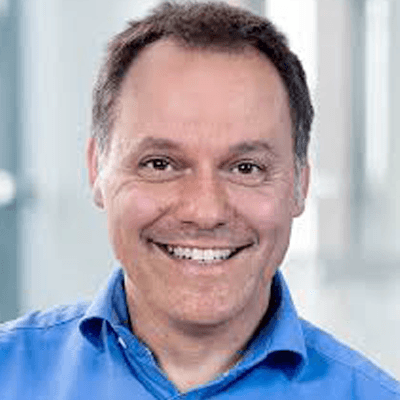
Dr Oliver Marchand
Climate risk modelling and fintech. Co-founder and former CEO of Carbon Delta, acquired by MSCI in 2019, where he went on to lead Global Climate Risk Research. PhD in Computer Science from ETH Zürich.


Book a demo and explore a guided 30-day trial for your sites.
See what the adaptation decision engine can look like for you.